EAT Communities
for Action

From Knowledge to Action: Driving the Food System Change We Need
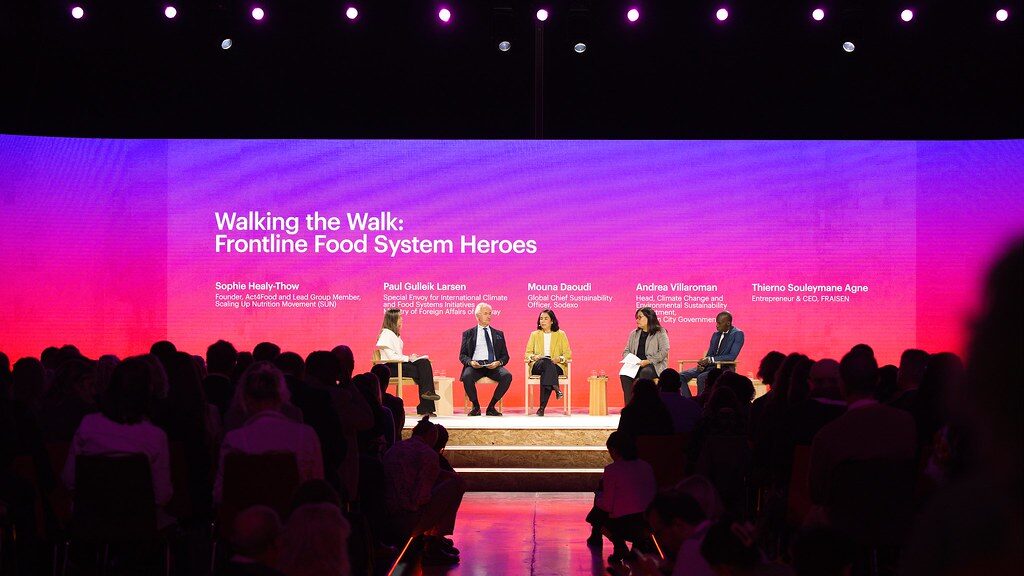
We are convinced that community mobilization is at the heart of the change we aim to catalyze, backed by the science the EAT-Lancet Commission provides – Fabrice DeClerck, Chief Science Officer, EAT
Communities for Action

Communities for Action are sector-specific groups committed to making ambitious progress on healthy, sustainable and just food systems, as outlined by the EAT-Lancet Commission recommendations.

The Communities for Action are an initiative led by EAT, Convene, and co-host organizations across sectors. Each Community for Action is co-hosted by global organizations with broad networks of actors engaged in food systems transformation. Collectively the ten Communities for Action launched in 2025 represent a broad swath of front-line food system actors, from production to consumption, whose day-to-day actions shape food systems. In 2025, the Communities for Action drew on the experiences of more than 700 individuals and 350 organizations from across all world regions. Over multiple engagements, each community identified ten actions to prioritize, five actions they are committed to stopping, and key collaborations needed to unlock progress. These recommendations draw on the experiences of these actors captured in 145 Stories of Progress, and summarized in Action Briefs which will be updated annually.

This work exists to close a familiar gap: Scientific findings can be clear, while implementation remains fragmented across sectors, budgets, mandates, and incentives. Communities for Action bring practitioners, decision makers, and scientists into the same room with the aim of making knowledge actionable, and action knowledgeable. While each Action Brief presents a translation of the EAT-Lancet Commission, for and by each actor, EAT and its partners actively curate a space for cross-community dialogue, for tackling cross-sector lock-ins.

What makes this different

Communities for Action do more than convene. While each community publishes its own Action Brief, research partners at the Stockholm Resilience Centre (SRC) run comparative analysis to identity common ambitions, tensions, and lock-ins across communities. This mapping of shared ambitions, bottlenecks and unlocks are used to strategically connect across communities, including through cross-community gatherings and key calendar moments such as the annual Stockholm Food Forum.

Purpose and objectives

Communities for Action aim to:

  1. Build inclusive communities of front-line food system actors, whose experience and leadership can influence positive change.
  2. Identify priority actions and solutions aligned with the EAT-Lancet recommendations, captured in sector specific Action Briefs.
  3. Connect across communities to identify shared action areas that need collaboration across sectors to catalyze impact.
  4. Bring recommendations into the Stockholm Food Forum and other global convenings to strengthen momentum for food systems transformation.
  5. Highlight ambitious stories of progress to shift the narrative from food system challenges, to solutions.
  6. Invite front line actors from across the food system identify key knowledge gaps to be addressed by EAT-Lancet Commissions.
How the communities work

The Communities for Action

  1. Mobilize: each community brings together leaders with diverse expertise, backgrounds, and geographies.
  2. Develop: participants identify priorities and draft an Action Brief grounded in EAT-Lancet Commission evidence.
  3. Connect: communities compare briefs to identify shared action areas and collaboration opportunities, then carry messages into major platforms and convenings including Stockholm Food Forum.
  4. Disrupt: the communities collectively build a risky safe space where high-tension topics locking in food system progress can be addressed and tackled.
What happened in 2025

Over 2025, the members developed:

  1. Communities were formed, and engaged with the science of healthy, sustainable and just food systems.
  2. Facilitated by
  3. Drawing from the science, and the Stories of Progress, each community developed an
  4. A cross-community Action Day with 100 representatives ahead of the Stockholm Food Forum, designed to surface shared priorities and partnership opportunities.

A practical lesson emerged throughout this process. Transformation accelerates when scientific evidence meets lived experience, and when collective effort reduces fragmentation.

The Communities for Action and their Co-hosts
  1. Chefs, restaurants and food service co-hosted by the Culinary Institute of America (CIA), the World Business Council for Sustainable Development (WBCSD) and the SDG2 Advocacy Hub.
  2. Cities co-hosted by C40 Cities, the Milan Urban Food Policy Pact (MUFPP).
  3. Consumers co-hosted by Act4Food and Consumers International.
  4. Farmers and fishers co-hosted by the Agroecology Coalition and Regen10.
  5. Food retailers and manufacturers co-hosted by the Consumer Goods Forum (CGF) and the World Business Council for Sustainable Development (WBCSD).
  6. Healthcare professionals co-hosted by PAN (Physicians Association for Nutrition) International.
  7. Indigenous peoples, an evolving collaboration facilitated by Hindou Oumarou Ibrahim (founder of the Association for Indigenous Women and Peoples of Chad and member of the EAT Advisory Board) in partnership with EAT.
  8. National policymakers co-hosted by the Alliance of Bioversity and CIAT and the Scaling Up Nutrition Movement (SUN).
  9. AgriFood Finance and trade actors co-hosted by the International Food Policy Research Institute (IFPRI), Organisation for Economic Co-operation and Development (OECD), and the Institute for Sustainable Development and International Relations (IDDRI)
  10. Science co-hosted by Nexus Action – Montpellier Process


Publication overview

Explore the Action Briefs

Action Briefs set priorities and recommended actions that organizations can use in policy, practice, and investment decisions. These are shared reference points for member organizations, partners, and the broader food systems community supporting alignment across sectors and scales. Use the Action Briefs to set priorities and align internal plans. An annual review of the Action Briefs will be coordinated and used as a mechanism to increase ambition, and strengthen the collective articulation of impact. The lived experiences of front-line actor engagement with transformation serve both as a driver of learning both within, and across communities, as well as a key input into asks for science.
Join the Communities for Action

Communities for Action are for organizations and individuals who can contribute expertise, practical experience, and the ability to act within their ecosystems.

Join a Community for Action if you are an actor in the food system, including practitioners, institutional leaders, and organizations with the capacity to adopt and champion actions.

The only commitment is meaningful participation in the community, including contributing to priorities and reviewing drafts, across the full process.

As part of a Communities for Action, you will get a clear set of actions tailored to your community, access to cross-community collaboration opportunities, documentation and learning through shared stories and platforms.

While EAT winds down in 2026, several actors have expressed support for the Communities for Action, including co-hosts whom are actively engaged individually and collectively. Nexus Action: the Montpellier Process will serve as an interim holding space for the Communities.

To request information or express interest, contact [email protected].